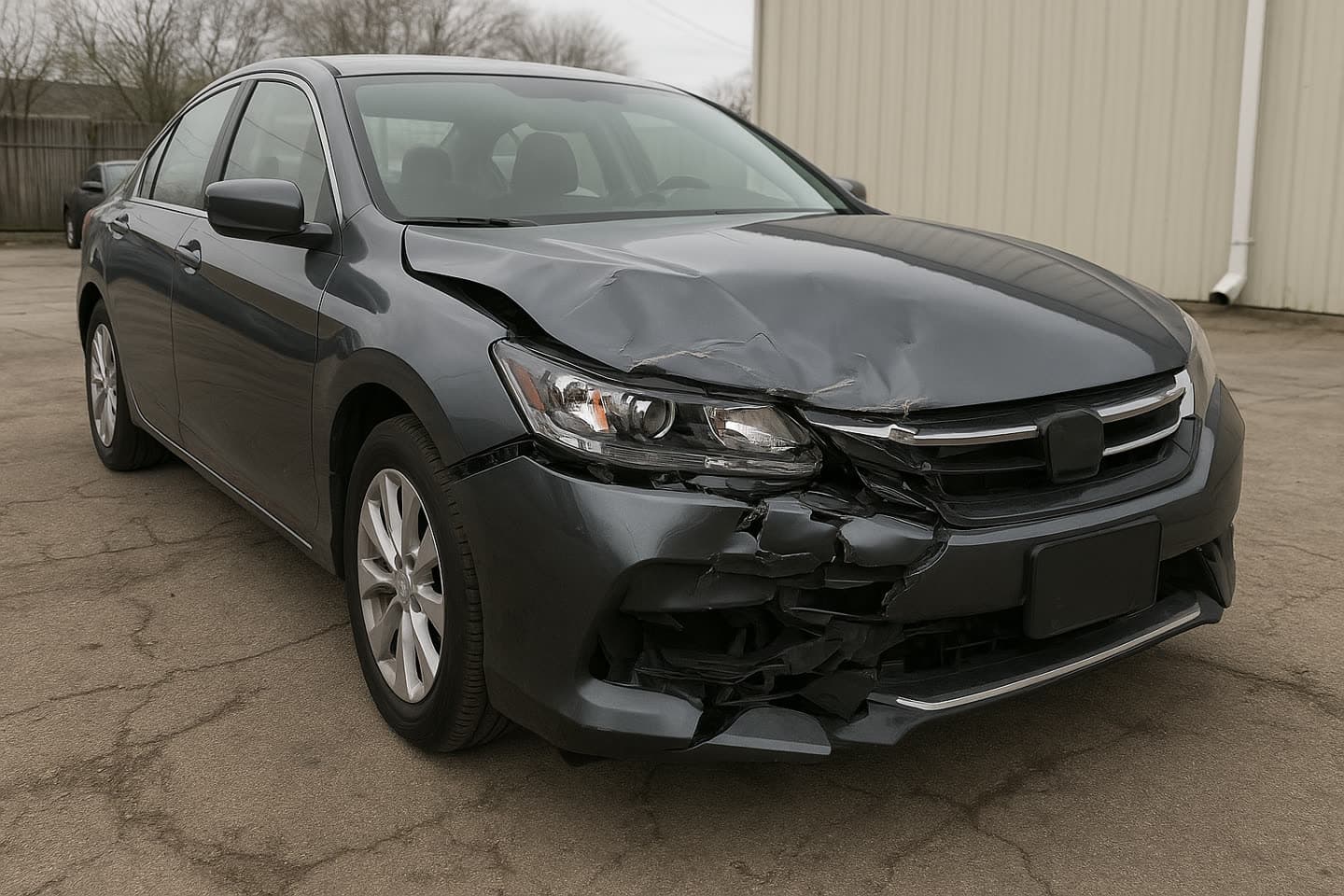
A model that knows where the damage is
Philotic Inspect is our first domain model. It reads a photo of a vehicle, finds the damage, and says what kind it is and which part it sits on. The output is a list of findings a person can accept, edit or reject, and every answer becomes a label for the next version.
We fine-tuned it from Qwen3-VL-8B, an 8-billion-parameter open foundation, on commercially licensed public photos of damaged vehicles, with no customer data. On photos it never saw, it names damage more accurately than Claude Sonnet 4.6 and Qwen3-VL-235B, a model with 29 times as many parameters, and it puts the damage on the right part far more often.
Benchmark performance
Every model saw the same images and the same question, and every result is on held-out data. Bars start at zero; the thin line on each bar is its 95% interval. Claude Sonnet 4.6 and Claude Opus 4.7 ran through their public API.
Damage type, per area
Is there damage in this area of the photo, and which of seven types is it? Eight answers, including no damage.
- Philotic Inspect75.6
- Image-embedding baseline75.6
- Claude Sonnet 4.650.0
- Qwen3-VL-235B48.1
- Qwen3-VL-8B, untuned46.3
n = 480 held-out areas, 60 per answer
A standard image-embedding classifier, run as a baseline, ties on type and trails by 17.6 points on part. On the same 480 areas, 137 are right only for Philotic Inspect and 14 only for Claude Sonnet 4.6.
View as table
Capabilities deep-dive
Finding damage on the whole photo
General models can often say what is damaged. Acting on it needs where. Here are five held-out photos, with how much of the labeled damage each system found. One of the five is a photo where we do worse.
| Held-out photo | Philotic Inspect | Claude Opus 4.7 | What happened |
|---|---|---|---|
| Front-end hit | 6 of 6 | 0 of 6 | Claude Opus 4.7 named a dented hood, a broken headlight and a broken bumper correctly, then placed all three boxes on the windshield and the building behind the car. |
| Rear bumper scrapes | 5 of 8 | 1 of 8 | Philotic findings sat on the scraped bumper and named it. Claude Opus 4.7’s boxes landed on the trunk lid above the badge. |
| Several small areas | 6 of 7 | 2 of 7 | Seven labeled areas on one vehicle. |
| Where we do worse | 0 of 2 | 1 of 2 | By the scoring rule, Philotic findings missed both labeled areas and Claude Opus 4.7 found one. We kept this case in the set. |
| Clean vehicle | Nothing flagged | Nothing flagged | An undamaged vehicle. Neither system flagged anything. |
Labeled areas found per photo, on the same scoring rule as the Damage found benchmark.
Severity, learned from graded examples: Philotic Grade
The layer that matters most is the one built from your own decisions, and no public dataset carries those. Public data does include graded dents, so we used them to show the mechanism: a small adapter on the same foundation, trained on one more kind of label, becomes one more capability. General models almost never call a dent minor, which would push every estimate built on them upward.
Minor dents recognized
Of the held-out dents labeled minor, the share each model also rated minor.
- Philotic Grade57.1
- Qwen3-VL-8B, untuned42.9
- Claude Sonnet 4.612.7
- Qwen3-VL-235B6.3
Methods
- DataCommercially licensed public photos of damaged and undamaged vehicles. Data with non-commercial or share-alike terms is excluded, and no customer data was used.
- Held-out setsAreas: 480 drawn evenly across eight answers for the head-to-head, and 3,430 for the full test. Whole photos: 200 that every system saw. Dents: 267. Part accuracy is scored only where a person outlined the vehicle’s parts.
- Clean areasThe full test includes 834 areas with no damage, so a model can’t score well by calling everything damaged. Philotic Inspect flags 4.2% of them.
- Whole photosHuman boxes range from a single scratch to a whole panel and are not exhaustive. A labeled area counts as found when a finding covers 30% of it or sits inside it; strict box matching is in each table.
- ConventionsPart of a fine-tuned model’s lead is learning how its training data was labeled. Trained on your records, it learns your conventions, which is the point of a model you own.
- StatisticsEach result carries a 95% interval. On damage type and on severity, paired tests on the same items put Philotic ahead of Claude Sonnet 4.6 and Qwen3-VL-235B with p < 0.001.
What comes next
The next step is a customer’s own data: photos paired with the decisions their people already make. Each confirmed decision becomes a training label, and each new kind of label becomes another adapter like Grade, trained and hosted for that customer alone and owned by them. Read how ownership works, or how we chose the foundation.